This article may contain affiliate links. I may earn a small commission at no extra cost to you. Learn More

Menu

Rusty staining, a metallic taste, and that unmistakable “well water” smell can turn everyday routines into constant cleanup—scrubbing toilets, rewashing whites, and wondering why your shower never feels truly fresh. When iron (and sometimes sulfur) shows up, you don’t just want “a filter”—you’re trying to land the best iron filter for well water for your home.
This roundup walks you through five strong whole-home options and explains what their real-world ownership feels like—water flow during busy mornings, how the system refreshes itself, and what you’ll be doing over time to keep results consistent.
Unlike our best water filter for well water guide, which focuses on well water in general, these reviews specifically showcase the best filters that reliably remove iron from well water.
To build this list, I compared product details carefully and focused on systems that target the everyday headaches iron water causes—staining, odor, and inconsistent water quality—while staying clear about setup and maintenance style.
For anyone narrowing down the best whole house iron filter for well water shortlist, this system centers on air-based oxidation, which means it uses an air pocket inside the tank to change iron, sulfur, and manganese into forms that are easier to capture. In day-to-day use, that translates to water that stops bringing the “rusty tint” into sinks and tubs and helps keep sulfur odor from riding along every time you turn on a faucet.

After the oxidation step, the system filters through a greensand fusion bed. The practical win is simple: the stuff that used to show up as discoloration and odor gets trapped instead of traveling through your home. When the system refreshes itself, it backwashes what it collected down a drain and rebuilds that air pocket, so performance stays steady instead of slowly fading.
SpringWell spells out removal targets clearly: it’s set to handle hydrogen sulfide up to 8 ppm, iron up to 7 ppm, and manganese up to 1 ppm. Those numbers matter because they help you match the system to your water test results without guessing. If your main pain points are staining and sulfur smell, that focus shows up where you feel it most—showers, laundry, and cleaning.
The control head adds a convenience layer you’ll appreciate once the system is installed. You can adjust settings like air draw, backwash cycles, and timing from your phone using Bluetooth, so tuning the system feels more like adjusting a home appliance than wrestling with a complicated control panel. You can also check status and water-use data, and you can start a backwash cycle from your phone when you want to reset things quickly.
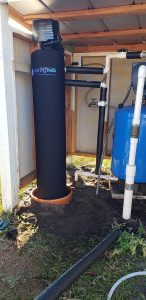
Noise and “equipment living space” are part of ownership with any backwashing system, and this one tackles that experience directly. It uses a slower release of the compressed air charge before backwash cycles, which helps avoid the sudden, jarring blast some older setups can create. If your equipment sits near a living area, that small detail makes the system feel more livable.
Sizing is straightforward for different home demands. The WS1 is aimed at 1–4 bathrooms with a 12 GPM service flow rate, a 10-inch tank width, and 1-inch connections. The WS4 targets 4+ bathrooms with a 20 GPM service flow rate and a 13-inch tank width. Both list operating ranges of 25–80 PSI, 36–120°F, and a pH range of 6.5–10, so you can sanity-check fit with typical plumbing conditions. It also comes with a 50-foot drain line and a spin-down sediment filter, which helps you start with a more complete setup.
Pros:
Cons:
If you’re weighing one of the best iron removal system for well water picks for a stubborn sulfur smell, this system is built around an oxidation-and-filtration combo that targets that problem aggressively. It uses hydrogen peroxide to oxidize iron and hydrogen sulfide, then relies on catalytic carbon media to finish the job by filtering what’s been oxidized. In everyday terms, it’s a “one-two” process designed to keep your water from announcing itself when you start a shower or fill a pot for cooking.
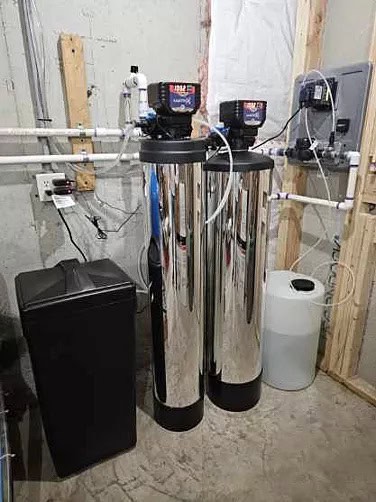
The system’s target ranges give you a clear sense of what it’s meant to tackle. It’s set up for iron up to 20 ppm, hydrogen sulfide up to 30 ppm, and manganese up to 1 ppm. It also operates effectively from pH 6 to 9. Those guardrails help you decide whether it aligns with your specific water conditions—especially if sulfur smell is the biggest driver behind your search.
Another piece of the puzzle is how it addresses bacteria tied to iron and sulfur issues. It’s built to work with iron- and sulfur-reducing bacteria (IRB and SRB). The practical value is that you’re not just trying to “cover up” an odor; you’re supporting treatment that accounts for common well-water contributors that travel with those smells.
Maintenance here leans into frequent refresh cycles. Automated backwashing runs approximately every two days, which helps keep the media bed clean and ready to keep filtering. In the most extreme situations, daily backwashing may be needed. The upside is consistency—your system stays in a rinse-and-reset rhythm instead of waiting until you notice problems.
Monitoring and control are also part of the ownership experience. An internal meter tracks gallons used and monitors flow rates, so the system stays aware of what your household is doing. On top of that, the smart valve connects to your phone via Bluetooth 5.0 through a companion app, so checking status and adjusting settings feels simple and accessible.
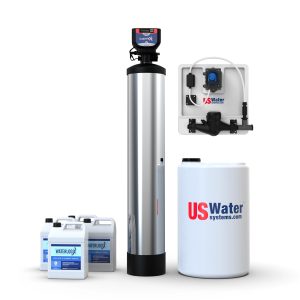
This system comes as a package built around peroxide-based oxidation. You get a 15-gallon peroxide tank, a Precision Injection Panel, the inFusion filter, and 10 gallons of H2O2 included. [1] That means you’re working with a setup that’s ready to run the oxidation process out of the box, and you’ll want enough space to place the additional tank and components neatly.
Pros:
Cons:
In the best whole house iron filter category, SoftPro’s approach uses Air Injection Oxidation (AIO), which relies on oxygen rather than chemical feeding in normal operation. Water gets oxygenated, then passes through a specialized filter bed that attracts and removes iron, sulfur, and manganese. In your home, that typically looks like fewer stains and less odor following you from shower to sink to laundry room.
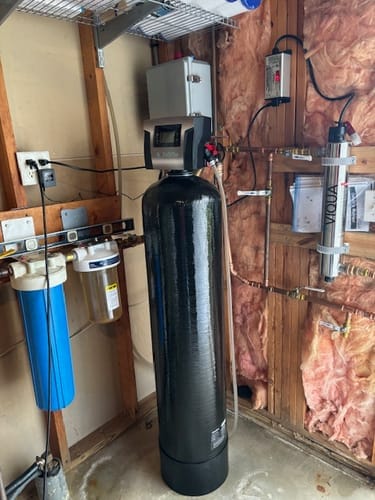
It’s also built for higher iron situations, which matters if your stains show up fast and your fixtures feel like they’re constantly losing the fight. The system is set up to remove iron up to 30 ppm, manganese up to 7 ppm, and hydrogen sulfide up to 5 ppm. It’s also designed to raise pH to 7.0+, which supports a more balanced feel if your well tends to run acidic. [2]
One of the most useful parts of this system is how clearly it ties sizing to real plumbing requirements. The 1.0 cubic foot option calls for a minimum 5 GPM flow rate, the 1.5 cubic foot option calls for a minimum 7 GPM, and the 2.0 cubic foot option calls for a minimum 10 GPM. That guidance pushes you to match the system to your well pump’s real delivery, so you get stable performance instead of forcing a mismatch.
The system regenerates by backwashing what it trapped and replenishing the oxygen supply. That “reset loop” keeps the filter bed from loading up over time. Ownership feels less like constant tinkering and more like a set routine that runs in the background.
Control and usability are designed to feel approachable. You get a 1-inch high-efficiency, high-flow valve, so your water use doesn’t feel choked during busy household moments. The 4-line LCD with electronic touchpad makes settings changes feel like operating a straightforward appliance rather than decoding a complicated controller.
A couple of daily-life modes help the system fit your schedule. Vacation mode pauses regeneration while you’re away. And if there’s no water use for seven days, it runs a quick refresh to help prevent bacteria growth in the softener. Those small touches make ownership smoother when life gets busy or you leave town.
Pros:
Cons:
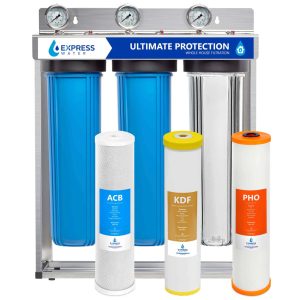
Among the best water filter for well water with iron contenders, this is the most straightforward “cartridge routine” option in the lineup, and it’s built around a clear three-stage flow. You get sediment filtration first, then an iron-and-manganese stage, followed by an activated carbon block. That layered path keeps grit and cloudiness from moving through your plumbing, while also cleaning up water for daily use like cooking and rinsing produce.
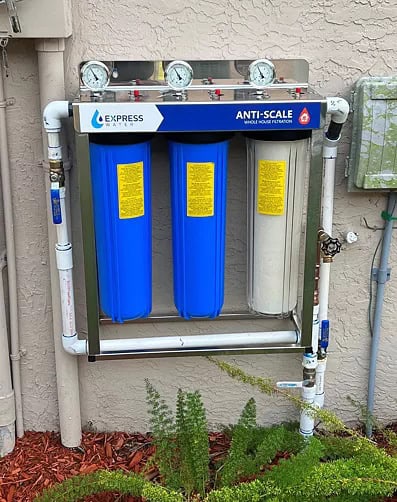
The carbon block stage targets chlorine and chloramines along with odors and cloudiness. In practice, your water tends to feel cleaner for everyday drinking and kitchen use. Since it’s a whole-house setup, you experience the change across showers, laundry, and dishwashing—not just at a single faucet.
For iron and manganese handling, the system uses Zeomangan media in the dedicated stage. It’s built to handle up to 0.2 ppm iron and 0.05 ppm manganese. That makes it a practical match when you’re dealing with lighter metal levels and want a simple way to keep staining and discoloration from becoming a constant chore.
Maintenance stays predictable because the design focuses on quick filter swaps. A typical filter set averages up to 100,000 gallons, or about 6–12 months in normal use depending on water quality, temperature, and pressure. That means you’re usually working with a “set it, live your life, swap it when it’s time” rhythm rather than a more involved regeneration cycle.
The system also lays out clear operating conditions that help you gauge fit. It lists a production rate of 0.25 gallons per second and an operating range of 40–80 PSI and 40–100°F (38°C). Those boundaries help you picture how it will behave in a typical home plumbing environment.
Space planning is part of ownership with any mounted cartridge system. This one lists a footprint of 29 ¼ inches high by 23 ½ inches long by 8 ½ inches deep. That makes it easier to plan where it will live and how comfortable filter changes will feel once it’s installed.
Pros:
Cons:
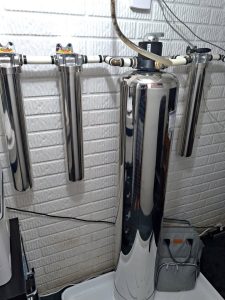
This iron filtration system takes a “layered treatment” approach and combines multiple filtration steps with a dedicated media tank aimed at common well-water headaches. The front end uses a 20-inch sediment cartridge, which helps catch grit before it travels deeper into your system. That keeps your water from feeling sandy and helps protect the rest of the filtration path from getting overwhelmed.
A 20-inch solid carbon cartridge sits as a finishing step. In everyday use, that helps your water feel cleaner for kitchen tasks—filling a glass, making tea, and rinsing food—because carbon typically improves that “clean water” experience. It’s a nice pairing with the rest of the system because it rounds out the whole-home treatment instead of focusing on one narrow problem.
The center of the setup is the mineral tank, which targets iron, manganese, and hydrogen sulfide. The practical takeaway is fewer rust-colored surprises and less odor showing up around the house. It’s designed for whole-home impact, so the benefits show up in showers, laundry, and cleaning routines—not just the taste at one tap.

Sizing options help you match the system to your household demand and your preference for longer media life. You can choose 1.5 cubic feet of media rated for 1,000,000 gallons or step up to 2.0 cubic feet rated for 1,500,000 gallons. That larger capacity path tends to feel less “maintenance-minded” over time because you’re working with a higher rated throughput.
Flow rate also changes with the size you choose, which matters in busy homes. The 1.5 cubic foot setup lists a service flow of 9–11 GPM, while the 2.0 cubic foot version lists 10–13 GPM. When multiple fixtures run at once, that extra breathing room helps your water use feel steady instead of strained.
Backwashing is part of how this system stays effective, and you can choose how it’s triggered. The default timer valve backwashes on a set schedule, while a metered valve option backwashes based on gallons used. That flexibility lets you choose a routine that fits your household—predictable scheduling or a refresh cycle that aligns more closely with actual water usage.
Pros:
Cons:
This quick buyer’s guide helps you sort through the real decision points—what you’re trying to fix, how your home uses water, and what kind of maintenance routine you’re willing to live with after the install.

If you keep asking what is the best filter to remove iron from well water, start by naming the main annoyance you want to eliminate, because different systems emphasize different strengths. When you choose a system that lines up with your most obvious symptom, the result feels satisfying quickly.
It also helps to think about where you want improvement first. Some households care most about bathroom staining and laundry; others care most about the kitchen and drinking water experience. A whole-house system touches everything, but your priorities determine which features matter most.

With iron water filtration, flow rate and household size matter, especially when multiple fixtures run at the same time. If you routinely have someone showering while the washer fills and a sink runs, you’ll appreciate a setup that supports stronger service flow. When a system matches your demand, your water pressure and “normal daily use” feel stable instead of compromised.
Sizing often shows up in clear ways: bathroom-based system options, or minimum flow requirements tied to media size. Those details exist for a reason. When you respect them, you avoid the frustrating situation where a system “fits on paper” but feels strained in real life.

For iron water purification, maintenance style varies widely: some systems rely on cartridge swaps, others rely on backwashing and regeneration cycles. Cartridge systems typically feel familiar—swap filters, move on. Backwashing systems feel more automatic, but you need a drain path and you’ll want to be comfortable with the idea of periodic rinse cycles.
Look for a maintenance rhythm that matches your personality. If you like a calendar-based routine, a predictable replacement cycle feels easy. If you prefer automation, systems with scheduled or metered backwashing keep performance consistent without you constantly thinking about it. [3]
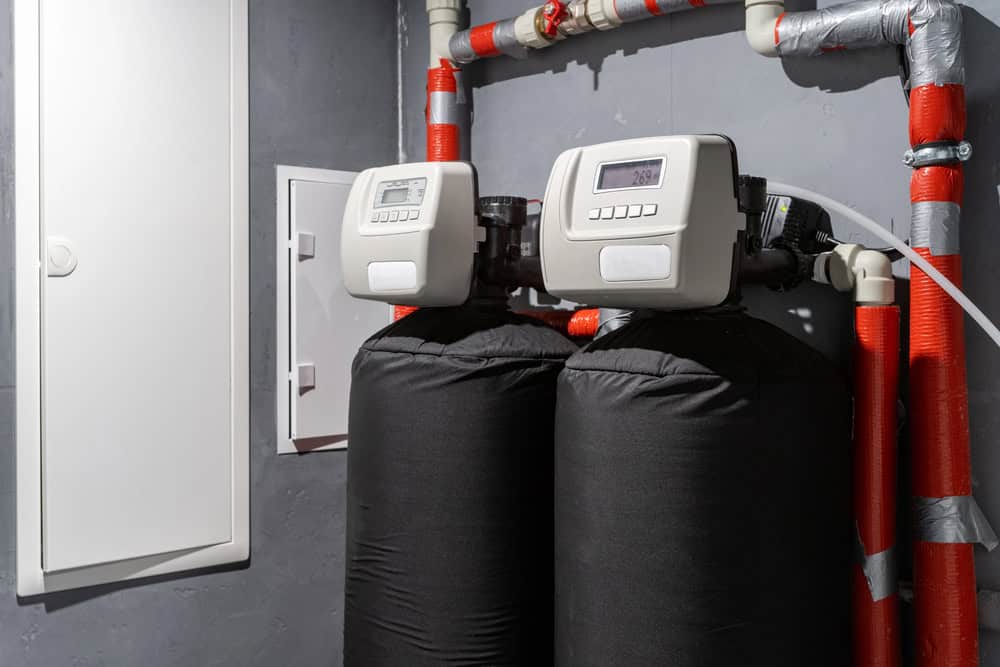
Some systems keep controls simple and local, while others let you adjust settings and check status from your phone. App-based monitoring is especially useful if you like the idea of checking usage, confirming the system is running properly, or starting a refresh cycle without walking into the utility area.
You don’t need advanced controls to get good water, but convenience features can make ownership feel smoother. When the interface is clear—whether it’s a touchpad display or a phone connection—you’re more likely to keep the system dialed in long term.
Whole-house iron systems often involve tanks, filter housings, and—depending on the setup—extra components like a peroxide tank. Before you choose, picture where everything will live and how you’ll access it for maintenance. Easy access makes filter changes and system checks feel simple instead of annoying.
Backwashing systems also require a drain path, so think about routing and placement early. When you plan for space and drainage upfront, installation feels cleaner and the system fits into your home like it belongs there.
Related Well Water Guides:
If you want a phone-friendly whole-house system built around air-based oxidation with clear sizing paths for different home demands, SpringWell stands out as a strong fit. If sulfur odor is your biggest driver and you want an oxidation approach paired with catalytic carbon and frequent automated backwashing, Matrixx InFusion matches that priority well.
For tougher iron levels with an air-injection style and clear minimum flow guidance that helps you size it correctly, SoftPro Iron Master AIO is a smart direction. If you prefer a straightforward cartridge routine with a three-stage layout and a predictable filter-change cadence, Express Water keeps ownership simple. And if you like a layered whole-home setup with sizing options, strong rated throughput choices, and flexible backwash control styles, Crystal Quest is worth a close look.
Your best choice comes down to your water issues, your home’s demand, and the maintenance rhythm you’ll actually keep. Scroll back up to the list, pick the iron removal system that fits your situation, and you’ll end up with water that feels easier to live with every single day.