This article may contain affiliate links. I may earn a small commission at no extra cost to you. Learn More

Menu

Microplastics are frustrating because they do not announce themselves. There is no obvious smell, no strange color, and no instant taste cue that tells you tiny plastic particles are part of the water conversation. For many people, the concern starts after thinking about laundry fibers, packaging, and everyday material breakdown ending up in water over time.
This guide breaks down five strong options for different homes and routines, so it gives you a clearer way to choose the best water filter for microplastics based on how much water you want treated, how much setup you want to deal with, and what kind of maintenance routine fits your life. Some are simple countertop systems, one is a distiller, one is a smart under-sink reverse osmosis system, and one takes the whole-house route.
I compared the product details carefully around microplastics performance, filtration method, daily usability, capacity, installation style, and upkeep. This is not a hands-on test; it is a practical buying guide built from the product information covered in the video script.
Next up for anyone researching the best under sink water filter for microplastics, Cloud RO is the most streamlined under-sink option in this guide, especially for someone who wants reverse osmosis without making the system feel old-fashioned or high-maintenance. It installs under the sink, uses a dedicated faucet, and focuses on giving you deeply filtered drinking and cooking water without taking over your countertop. For microplastics, the key appeal is the reverse osmosis approach itself: water is pushed across a membrane, while material larger than a water molecule is sent to the waste side.
The filtration path is layered in a way that makes sense for everyday use. Water first moves through a 5-micron sediment filter, then through a carbon block filter with a 1-micron pore size, then through an RO membrane rated for 80 gallons per day. After that, the remineralization stage adds trace minerals back and leaves the water alkaline. That sequence gives you water that goes through serious purification, then comes out with a more pleasant finished character for drinking.
Cloud RO is also built around a smoother sink experience. The internal hydraulic pump and 2.8-gallon holding tank mean the system is not just relying on a slow, frustrating trickle when you need water. With a faucet flow rate around 0.625 gallons per minute and outlet pressure in the 40–45 psi range, filling a glass, bottle, or pot feels more natural in normal kitchen use.
Efficiency is another major part of the appeal. Cloud RO has a 1:1 waste ratio, so the system is designed to waste far less water than older RO setups that send much more water down the drain. That matters for anyone who wants the purification logic of reverse osmosis but does not want the ownership experience to feel outdated.
The smart side is where Cloud RO separates itself from simpler under-sink systems. Sensors monitor TDS, pressure, and leaks, and the system connects to an app. That means you are not left guessing about key system conditions or waiting until something feels off at the faucet. It is also battery powered, and installation is positioned as a typical 30–60 minute job for someone comfortable working under a sink.
Filter upkeep is straightforward compared with more hands-on routines. For a family of four, replacements are generally every 9–12 months, giving the system a predictable maintenance rhythm. If you want an under-sink RO system with strong microplastics logic, app-connected monitoring, remineralized output, and a cleaner ownership flow, Cloud RO is the strongest fit here.
Pros:
Cons:
Next up in this best home water filter for microplastics comparison, the Aquasana Clean Water Machine is the strongest compact countertop choice for someone who wants direct microplastics performance without installing anything under the sink. It is a powered countertop system, so the routine is simple: fill the tank, plug it into a standard outlet, and filter water right where you use it. That format works especially well for kitchens, apartments, shared spaces, or anyone who wants filtered water without making plumbing changes.
This system holds 64 ounces and delivers an 8-ounce glass in 8 seconds. That speed changes the way a countertop filter feels in daily life. Instead of waiting around for gravity to do the work, you get a fast pour for water bottles, glasses, coffee, tea, and cooking prep. The easier a filter is to use, the more naturally it becomes part of the day.
For microplastics specifically, Aquasana has one of the clearest performance profiles in this lineup. It reduces microplastics by 99.6% in the 0.5 to less-than-1-micron range. It is also WQA certified to NSF and ANSI 42, 53, and 401. That gives this unit a very specific role: a fast countertop filter with certified support for the particle size range many shoppers are worried about.
The broader filtration story is strong as well. Aquasana connects this system to reduction of 78 contaminants, including lead, PFAS, and VOCs. It uses Claryum filtration with four different filtration methods, so you are not relying on a basic taste-and-odor filter alone. At the same time, it retains beneficial minerals like calcium, potassium, and magnesium, so the finished water does not feel stripped down.
Aquasana also keeps the maintenance routine easy to understand. The filter is rated for 300 gallons, and replacement is every 6 months or 300 gallons. The swap is a simple pop-out, press-in, and flush process. That makes it a practical choice for someone who wants certified microplastics reduction but does not want a complicated service schedule.
The 1-year warranty and 90-day satisfaction guarantee add to the appliance-like feel. This is not the largest-capacity option here, and it is not designed for every faucet in the home, but it is highly compelling if your priority is fast filtered drinking water from the counter. For many households, that is the most realistic daily solution.
Pros:
Cons:
If you are comparing the best microplastics water filter options and want a non-electric setup, the BOROUX Legacy takes a completely different path from Cloud RO and Aquasana. Instead of pumps, electronics, or plumbing, it uses gravity. You pour water into the upper chamber, gravity pulls it through the filters, and filtered water is ready at the spigot. For people who want microplastics filtration with a very visible, low-tech routine, that simplicity is the main attraction.
This is a 3-gallon countertop gravity-fed system, so it fits best when you want filtered water ready on the counter rather than filtered directly from a faucet. There is no under-sink installation, no power cord, and no plumbing work. That gives it a practical edge for renters, busy households, or anyone who wants a system that stays easy to understand every time it is used.
Microplastics performance is a key reason this system belongs near the top of the list. The Foundation Filters are WQA certified to NSF and ANSI 42, NSF, ANSI, and CAN 401 and 372, and the system is specifically certified for microplastics in the 0.5 to 1 micron range. That direct microplastics certification gives the BOROUX Legacy a more focused role than a general countertop taste filter.
The contaminant coverage is broader than microplastics alone. BOROUX pairs the system with third-party verified performance across 80+ contaminants, including lead, fluoride, and pharmaceuticals. That helps the system feel like a more complete countertop filtration choice rather than a single-issue purchase.
The flow rate depends on how many filters are installed. With two filters, the Legacy is rated at 2 gallons per hour. With four filters, that increases to 4 gallons per hour. The system comes in either a 12-month setup or a 24-month setup depending on the filter configuration, so the larger setup gives you a longer service window and a faster gravity flow rate.
The build is also made for long-term countertop use. The chambers use high-grade 304 AISI stainless steel, and the spigot is stainless steel with a ceramic valve. The Legacy System includes a lifetime warranty. Maintenance is still part of the routine: monthly cleaning keeps the system fresh, and the Foundation Filters should be scrubbed every 3 to 6 months or whenever flow slows down. For a non-electric countertop system with certified microplastics coverage, BOROUX Legacy is a very strong option.
Pros:
Cons:
For shoppers looking beyond the best water filter pitcher for microplastics category, the Pure Water Mini Classic Countertop Water Distiller is the easiest product in this guide to understand from a process standpoint. It boils water into vapor, condenses that vapor back into water, and leaves contaminants behind in the boiling tank. For microplastics, that process is appealing because the finished water comes from condensed vapor rather than from the original water with tiny solids still moving through it.
This is a countertop system with no installation required. That makes it a good fit for someone who wants a serious separation method without adding plumbing, a faucet, a tank under the sink, or a whole-home system. You fill the boiling tank, press a button, and return later to finished water in the collection jar.
The production pace is slower than the powered filter options in this roundup, but it is easy to plan around. The unit makes about 3 liters in around 3½ hours. That rhythm works best for drinking and cooking water when you are comfortable making batches ahead of time. It is not designed to instantly fill glass after glass on demand.
The collection setup is another strength. The Mini Classic includes a non-toxic 1-gallon glass jar, so finished water is stored in glass instead of sitting in plastic. For shoppers thinking about microplastics, that detail lines up well with the reason they started comparing systems in the first place.
The materials and finishing steps also support long-term use. The boiling chamber uses T-304 grade stainless steel, giving the heated side a durable, clean-handling design. After distillation, the water passes through a carbon filter to absorb possible VOCs. That gives the system both distillation and a final carbon stage before the water reaches the jar.
The ownership routine is simple, but it is still a routine. You fill it, run it, pour from the jar, and keep water ready in the fridge. Filters are available in multi-packs intended as a year supply, so planning ahead is straightforward. If your priority is a tangible, easy-to-visualize purification process and you do not mind batch production, the Mini Classic is a strong countertop distillation pick.
Pros:
Cons:
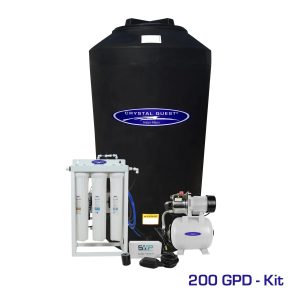
If you are deciding between the best water filter to remove microplastics systems for full-home coverage, the Crystal Quest Whole House Reverse Osmosis System is the largest-scale option in this guide. Instead of focusing on one glass, one countertop, or one sink, it is built to send purified water throughout the entire home. That means the water used for drinking, cooking, showering, and every faucet is part of the same filtration plan.
This system makes the most sense for someone who views microplastics as a whole-home water concern rather than a kitchen-only issue. A countertop unit or under-sink system focuses on a specific use point. Crystal Quest takes the infrastructure route, which is a better match when the goal is treated water across the full household.
Sizing is one of the most important details. The system comes in nine flow-rate sizes from 200 to 7,000 gallons per day. That range lets the setup match anything from a smaller home to a much larger household demand. Whole-house filtration only feels practical when the flow rate lines up with real use, and this range gives the system room to fit very different homes.
The storage-tank versions are designed around having treated water ready. They pair the RO unit with an atmospheric tank in 165-, 220-, or 500-gallon sizes. A pump sends water from the tank into the home as needed, while float switches manage system on-and-off operation based on tank level. That arrangement supports whole-home use better than expecting a small RO unit to keep up at every moment.
The filtration hardware is serious. The system uses commercial-grade reverse osmosis with prefiltration to extend membrane life. It has minimum NaCl rejection of 96% and reaches up to 98.5%, with an operating pressure range from 50 to 150 psi. For homeowners comparing whole-house purification options, those details show that this is a full water infrastructure purchase rather than a small accessory.
Long-term ownership is also part of the value story. The systems are modular, factory-tested before shipping, and built with easily accessible components. With regular prefilter and membrane changes, they should last 15 to 20 years. Optional add-ons include a 12 GPM UV sterilizer and remineralizer setups, so the system gives you room to shape the final water after RO. For full-house RO treatment, Crystal Quest is the most comprehensive option in this roundup.
Pros:
Cons:
Choosing a water filter for microplastics starts with deciding where you actually want treated water. Some shoppers only care about drinking and cooking water, while others want filtration at every faucet. This buyer’s guide walks through the main tradeoffs so the right format becomes easier to spot.
When you are comparing the best water filter for removing microplastics choices, countertop filters are the simplest place to start because they keep the system visible and close to where you drink water. Aquasana gives you a powered countertop setup with a fast pour, while BOROUX gives you a non-electric gravity routine. The Mini Classic takes a batch-based distillation path, so it works best when you are comfortable preparing water ahead of time.
Under-sink reverse osmosis is a better fit when you want filtered water from a dedicated faucet without keeping a system on the counter. Cloud RO fits that role with a holding tank, pump, remineralization, and app-connected monitoring. For people who want a cleaner sink area and a more permanent drinking-water setup, that format makes a lot of sense.
Whole-house reverse osmosis is a different category altogether. Crystal Quest belongs in homes where treating every faucet is the priority. It requires more planning than a countertop system, but it also addresses the widest set of household water uses.
When you are comparing microplastics water filter performance, the clearest microplastics claims in this guide come from Aquasana and BOROUX. Aquasana reduces microplastics by 99.6% in the 0.5 to less-than-1-micron range and is WQA certified to NSF and ANSI 42, 53, and 401. BOROUX is certified for microplastics in the 0.5 to 1 micron range and uses Foundation Filters with WQA certification tied to NSF and ANSI 42, NSF, ANSI, and CAN 401 and 372.
Reverse osmosis and distillation use different logic. Cloud RO relies on RO separation, moving water across a membrane and sending larger material to the waste side. Crystal Quest applies reverse osmosis at whole-home scale. The Mini Classic distills water by boiling it into vapor and condensing it back into water, leaving contaminants behind in the boiling tank.
The practical takeaway is simple: choose certified microplastics reduction when you want the most direct performance statement, choose RO when you want membrane-level separation, and choose distillation when you prefer a process that physically separates finished water through vapor and condensation.
Capacity changes the ownership experience more than many shoppers expect. Aquasana holds 64 ounces and focuses on fast access, delivering an 8-ounce glass in 8 seconds. BOROUX holds 3 gallons and uses a larger countertop reservoir, which works well when you want filtered water available from a spigot throughout the day.
The Mini Classic makes about 3 liters in around 3½ hours, so it fits a make-ahead routine. That pacing is not instant, but it is predictable. If you like having a jar ready in the fridge and running another batch when needed, the distiller’s rhythm is easy to understand.
Cloud RO and Crystal Quest solve capacity differently. Cloud uses a 2.8-gallon holding tank for under-sink drinking water, while Crystal Quest storage-tank versions use 165-, 220-, or 500-gallon atmospheric tanks for whole-home use. The right choice depends on whether you want a drinking-water supply, countertop reservoir, batch jar, or treated water throughout the house.
The best system is the one whose upkeep you will actually follow. Aquasana is simple here: replace the filter every 6 months or 300 gallons, then pop out, press in, and flush. Cloud RO has a longer replacement rhythm, generally every 9–12 months for a family of four, with sensors and app connection to reduce guesswork around TDS, pressure, and leaks.
BOROUX has fewer electronic parts, but it asks for more hands-on cleaning. Monthly cleaning is part of the routine, and the Foundation Filters should be scrubbed every 3 to 6 months or whenever flow slows. That is not complicated, but it does require a user who is comfortable maintaining a gravity system.
The Mini Classic needs a repeated fill-run-pour rhythm, plus carbon filter planning. Crystal Quest is a larger long-term system, with regular prefilter and membrane changes supporting an expected lifespan of 15 to 20 years. Before choosing, picture the maintenance routine six months from now, not just the first week after setup.
Most people start by thinking about the water they drink. For that need, Aquasana, BOROUX, Mini Classic, and Cloud RO all stay focused on drinking and cooking water in different ways. Aquasana emphasizes speed, BOROUX emphasizes gravity-fed simplicity, Mini Classic emphasizes distillation, and Cloud RO emphasizes under-sink RO with smart monitoring.
Whole-home treatment is the reason Crystal Quest exists in this list. It is the only option here designed to send purified water throughout the home, including the water used for cooking, showering, and every faucet. That makes it a better fit for someone who wants a complete water project instead of a single-point drinking-water upgrade.
The choice comes down to scope. If your concern is the water that goes into glasses, bottles, tea, coffee, and cooking, a countertop or under-sink option keeps things simpler. If your concern extends to the whole plumbing system, Crystal Quest is the more appropriate direction.
Cloud RO is the best fit for someone who wants an under-sink reverse osmosis system with a more modern ownership experience. The membrane-based RO process, remineralization stage, internal pump, 2.8-gallon holding tank, 1:1 waste ratio, and app-connected monitoring make it especially appealing for drinking and cooking water at the sink.
Aquasana Clean Water Machine is the best compact powered countertop choice. It stands out for 99.6% microplastics reduction in the 0.5 to less-than-1-micron range, WQA certification to NSF and ANSI 42, 53, and 401, fast 8-second glass filling, and a very simple 6-month or 300-gallon filter routine.
BOROUX Legacy is the best non-electric gravity option. It is certified for microplastics in the 0.5 to 1 micron range, holds 3 gallons, uses stainless steel construction, and gives you a straightforward countertop setup without plumbing or power.
Pure Water Mini Classic Countertop Water Distiller is best for someone who likes a visible separation process. It boils water into vapor, condenses it back into water, stores finished water in a glass jar, and uses a stainless steel boiling chamber with a carbon filter after distillation.
Crystal Quest Whole House Reverse Osmosis System is best for full-home treatment. It offers nine flow-rate sizes, large atmospheric tank options, commercial-grade RO, and a modular design built for long-term whole-house use.
The right choice depends on how you want filtered water to fit your home, so use this best water filter for microplastics guide to match the system to your space, routine, and treatment goals. Pick Aquasana or BOROUX for countertop convenience, Cloud RO for under-sink reverse osmosis, the Mini Classic for distillation, or Crystal Quest for whole-home RO treatment. Scroll back to the reviews, compare the systems side by side, and choose the one that fits the way you actually use water every day.