This article may contain affiliate links. I may earn a small commission at no extra cost to you. Learn More

Menu

Hard water has a way of turning small chores into constant chores. You wipe the faucet and it looks fine—then the spots come right back. The shower glass starts to haze. Your kettle picks up that chalky crust. And over time, the buildup doesn’t just look annoying—it starts to feel like your home is harder to keep up with than it should be.
Salt-free systems take a different path than traditional softeners. Instead of swapping minerals out of the water, they focus on stopping scale from clinging to surfaces in the first place. This roundup helps you sort out which option fits your home by looking at real-life priorities like flow for busy households, how the setup typically installs, what maintenance feels like, and where water chemistry matters. If you’re searching for the best salt free water softener picks, the goal is to make the decision feel simpler and more confident.
To build this best water softener list, I compared product information carefully to find strong options for reducing scale stickiness, keeping ownership simple, and matching different home sizes and water conditions. The goal here is clarity—so you can choose a system that fits the way you actually use water every day.
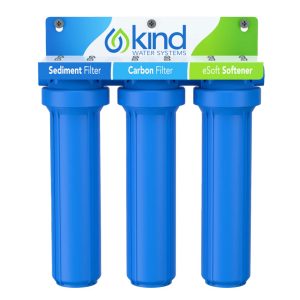
If you’re shopping for the best salt free water softener and filtration system category for city water, this option takes a combo approach. It’s built as a whole-house filter and salt-free softener setup for city water. That means you’re not just thinking about fixtures and buildup—you’re also thinking about how your water smells and tastes across the house.
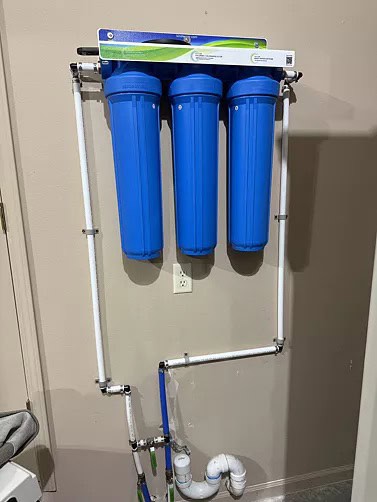
The three-stage layout is easy to understand because each stage has a clear job. Sediment filtration handles the stuff you don’t want floating through the system. A carbon block stage targets chlorine, so the water coming from the tap smells less like a pool and feels cleaner for drinking and cooking. Then the salt-free conditioning stage focuses on scale behavior, so you’re not constantly battling hard-water buildup on surfaces.
That conditioning stage uses Template Assisted Crystallization, which changes scale-forming minerals into a form that’s less likely to stick. The practical result is less of that gritty film feeling on fixtures and less of the “crusty edge” problem that shows up around water lines. You keep calcium and magnesium in the water, but the goal is to make those minerals behave in a way that’s easier on your home.
Flow and coverage are also framed in a way that’s easy to picture. The system is designed for high flow rates up to 15 GPM and is positioned for homes with up to five full bathrooms. That combination matters because it’s the difference between a system that feels fine on paper and one that still feels strong when the house is busy.
Placement feels more flexible than many whole-home systems because it’s designed around wall space rather than floor space. It typically needs about 3–4 feet of wall space and doesn’t require floor space, which helps if you’re working in a tighter utility area. It also doesn’t require electricity, so you’re not forced into a specific corner just to reach an outlet.
Maintenance is a predictable routine instead of a constant nag. Filter changes fall into a 6–12 month range depending on your water quality, and the swap is designed to take just a few minutes without calling a plumber. Add in certifications to NSF/ANSI 42, 61, and 372, plus a lifetime warranty and a 120-day satisfaction guarantee, and it’s built to feel like a well-supported, all-in-one upgrade.
Pros:
Cons:
If you’re narrowing down the best salt free water softener system shortlist for scale control, this system starts with a straightforward approach: it changes how hard-water minerals behave so they’re less likely to latch onto plumbing and surfaces. In day-to-day use, that shows up in the places you notice most—showerheads that stay cleaner longer and faucets that don’t feel like they’re constantly collecting buildup. [1]
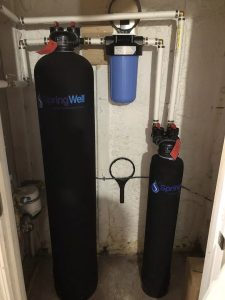
A big part of the experience is consistency at different flow rates. The design focuses on keeping the conditioning media working smoothly even during low-flow moments—like when you’re rinsing a dish or filling a glass—so the system doesn’t only “feel effective” when the house is running full blast. The practical payoff is simple: your water use stays normal, and the system keeps doing its job in the background.
Sizing is also refreshingly easy to think about because it’s framed around bathroom count and service flow. There’s a model aimed at 1–3 bathrooms with a 12 GPM service flow, another built for 4–6 bathrooms with a 15 GPM service flow, and a higher-capacity option built for 7+ bathrooms with a 20 GPM service flow. That makes it easier to pick a setup that won’t feel strained when multiple showers or appliances overlap.
The operating ranges help you understand what “normal household conditions” look like for this unit. It’s set up to run within 20–80 psi of pressure and a recommended temperature range of 34–120°F. It also tolerates free chlorine up to 3 ppm, which matters if your water supply is chlorinated and you want a conditioner that fits that reality without making the setup feel delicate. [2]
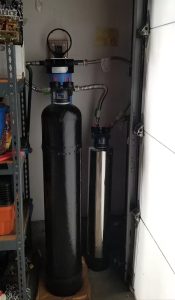
Maintenance stays simple and predictable because the routine focuses on a pre-filter. You’re working with a 5-micron pre-filter inside the blue canister, and you replace it every 6–9 months. That means you’re not stuck in a constant monthly cycle—you just plan a couple of swaps a year, and the system keeps moving.
Installation feels more straightforward because the included pieces cover the basics you typically want ready to go. You get the sediment filter housing, a spanner wrench, the 5-micron filter, a mounting bracket, and 1-inch MNPT fittings. And with a manufacturer’s lifetime warranty against defects on covered items, it’s positioned as a long-term install you set up once and rely on.
Pros:
Cons:
If you’re deciding between the best saltless water softener system setups for city water, this one leans hard into simplicity. It’s built for city water and focuses on reducing the hassle that pushes many people away from traditional softeners in the first place. The result is a more straightforward “install it and live your life” direction, without turning water treatment into a constant project.
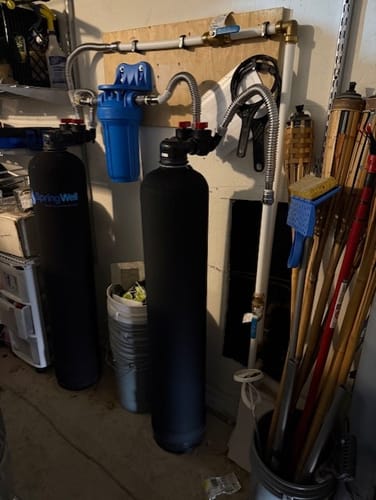
A key theme here is installation comfort. The setup is presented as an easy install that works as a straightforward drop-in on your main line. That matters because the fastest way to abandon a water upgrade is to choose something that feels complicated before it’s even running.
The design also points toward a component-based ownership experience. You’re working with a top-mounted valve section and a dedicated conditioner cartridge, which frames maintenance as occasional component swaps rather than a complicated rebuild. In practice, that keeps your routine focused and less fussy over time.
Day to day, the biggest benefit is what you don’t have to do. Because it’s a salt-free conditioner, you’re not building your routine around hauling salt, storing it, or thinking about salt-related upkeep. That makes it a good fit if your priority is lowering “water-system babysitting” more than anything else.
Confidence matters with a whole-home purchase, and this one puts that front and center with a six-month money-back window. That gives you time to live with the system through real routines—laundry weeks, back-to-back showers, and regular cleaning—before you decide it’s the right fit. It also comes with a lifetime limited warranty, which supports the long-term ownership angle.
This is the kind of pick that suits people who want simple, direct, and low-drama. If your goal is to get into salt-free conditioning without overthinking the details, and you value strong purchase reassurance, it fits that lane cleanly.
Check out my detailed SoftPro water softener reviews if you'd like to learn even more about the great water softeners this brand has to offer.
Pros:
Cons:
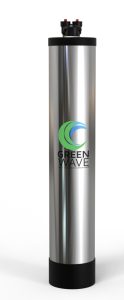
If you’re trying to pick from the best salt free water softener systems contenders and you like clear technical guardrails, this is the most “rules-first” option in the list. It uses an upflow fluidized bed design that keeps the media moving so the water stays in active contact with it. The idea is to avoid dead zones and keep treatment more consistent inside the tank.
The treatment method uses catalytic crystallization that converts calcium bicarbonate into stable calcium carbonate crystals. In everyday terms, that’s about keeping scale from forming hard deposits where you least want it—inside plumbing, on fixtures, and in water-heating equipment. You’re not stripping minerals out of the water; you’re aiming to keep them from acting like glue.

Ownership stays hands-off because it’s built to run without salt, without backwashing, and without regeneration. That’s a meaningful quality-of-life improvement if you want fewer moving parts and fewer routine chores. Once it’s installed and paired correctly to your water, it’s positioned as the kind of system you don’t have to babysit.
Sizing is practical because it’s laid out in flow tiers. You choose a model with a max service flow of 10, 15, or 20 GPM depending on what your household needs. That makes it easier to match the system to how your home actually runs during peak usage, like when showers and appliances overlap.
The basic operating ranges match what most households deal with. It’s rated for 40–110°F water temperature and 15–100 psi water pressure, and it uses a 1-inch MNPT connection. Those details matter because they help you avoid buying something that only works in a narrow window or requires unusual plumbing changes.
Where this system gets very specific is water chemistry compatibility. It’s rated for pH 6.5–8.5 and includes maximum levels for ferrous iron (0.3 mg/L), manganese (0.05 mg/L), and copper (1.3 mg/L). It also lists a chlorine maximum of 0.05 mg/L, which means it pairs best with upstream chlorine removal so the media stays in its intended range. If you like clear boundaries and a technical match to your water, that specificity is a feature, not a flaw.
Physically, it stays compact for a whole-house tank, with roughly a 9–10 inch diameter footprint and height options around 40.25, 45.5, or 52.5 inches depending on the model. The media typically runs about 4–6 years in normal use, so you’re planning maintenance in multi-year intervals rather than monthly cycles. Overall, it’s a strong fit for shoppers who want a salt-free system with clear flow choices and chemistry rules that keep expectations realistic.
Pros:
Cons:
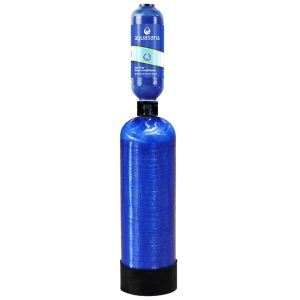
If you’re comparing the best no salt water softener systems lineup and you want a clearly structured maintenance rhythm, this one stands out for how “mapped out” the ownership feels. It uses a scale-control approach that turns dissolved hard minerals into inactive microscopic crystal particles. In practical terms, you keep calcium and magnesium in the water, but you reduce the tendency for scale to cling to surfaces.
The system uses an upflow, dual-tank design, which focuses on giving the water more contact time with the conditioning media. That matters because scale control is all about consistent interaction as water moves through the system. It’s also built around a tank replacement concept that aims to keep long-term ownership simpler when the time comes.

Flow is framed in a helpful way because you see both a peak number and a baseline testing number. [3] The peak flow rate goes up to 15.3 gallons per minute, so it’s positioned to keep up with a busy home. There’s also a rated flow rate of 7.0 gallons per minute for contaminant reduction testing, which gives you a steady reference point for performance at a measured pace.
Installation stays simpler because it runs without electricity and doesn’t require a drain line for wastewater. That’s a practical benefit if you don’t want the project to expand into electrical planning or drain hookups. It keeps the setup closer to a straightforward plumbing install rather than a multi-step buildout.
Fit matters with any salt-free approach, and this system spells out its best-fit water window clearly. It’s designed for hardness below 15 grains per gallon, alkalinity under 250 mg/L, pH below 8.3, and iron under 0.3 ppm. That kind of clarity helps you avoid a mismatch, because salt-free performance depends heavily on your incoming water conditions.
Maintenance is built into the package with both a 20-inch pre-filter and a post-filter included. The pre-filter follows a replace-every-2-months cadence, and the post-filter runs on a replace-every-6-months cadence, so the routine is predictable. The conditioner itself is designed for up to 10 years or 1,000,000 gallons of scale protection with a replace-every-10-years plan, and it’s backed by warranty coverage listed at 10 years / 1,000,000 gallons plus a 90-day guarantee.
Pros:
Cons:
This buyer’s guide helps you evaluate the practical differences that matter most—so you can pick a system that fits your home’s demand, your water’s chemistry, and the maintenance routine you’ll actually stick with.
Salt-free conditioners aim to reduce scale buildup by changing how minerals behave, not by removing minerals from the water. That’s a key expectation-setter, because it frames what you’re buying: less scale that sticks to plumbing and fixtures, not a complete mineral swap.
If your main frustration is stubborn buildup on faucets, showerheads, glass, and water-heating equipment, this approach lines up well with your goals. You’re choosing a “make scale less clingy” strategy, so cleaning typically feels easier and maintenance feels lighter over time. [4]

Flow is where a lot of whole-home purchases quietly succeed or fail. If your system feels underpowered during peak use, you notice it immediately—showers feel weaker, and the house starts to feel like it has to “take turns” using water.
Look for sizing that matches how your home actually runs. Some systems spell this out in bathroom-based sizing with service flow numbers, while others offer multiple model tiers like 10, 15, or 20 GPM. When the flow tier matches your demand, water use stays comfortable even when multiple fixtures run at once.
Salt-free performance depends on incoming water conditions, so chemistry guardrails matter. Some systems give a clear “best-fit window” for hardness, pH, alkalinity, and iron, which makes the buying decision more confident and less guessy.
If a system sets strict limits—especially around chlorine—you’ll want to treat that as a real planning point. Pairing with upstream chlorine removal may be part of the intended fit, and matching those boundaries helps the media keep doing its job consistently over time.
Maintenance isn’t just about how often you change something—it’s about whether the routine feels realistic. Some systems are built around periodic filter swaps every few months, while others focus on multi-year media life with replacement further down the road.
Use the schedule as a decision tool. If you like a simple calendar-driven routine, a system with clear pre-filter and post-filter intervals will feel easier to live with. If you want one of the best saltless water softener picks that stays low-touch after install, a multi-year media lifespan typically feels like a better fit.

A whole-home system is a long-term decision, so warranty structure and satisfaction windows help you feel secure in your choice. A longer satisfaction period gives you time to judge the experience across normal routines—cleaning, laundry, showers, and seasonal changes in water use.
A strong long-term warranty supports the “install it and rely on it” goal. If you’re deciding between two options that both match your home and water, the one that makes you feel more confident after purchase often becomes the better long-term fit.
If you want strong published flow choices and a design that stays consistent even during low-flow use, SpringWell is a great fit—especially when you’re sizing by bathrooms and prioritizing an easy, predictable routine. If you want a whole-home combo that tackles chlorine taste and smell while also addressing scale behavior, the Kind Water E-3000 stands out for that “one system, multiple improvements” direction.
If you like tight technical guardrails and clear model tiers by flow, the GreenWave approach makes sense, especially when your water chemistry fits the defined ranges. If you prefer a highly structured ownership plan with clear filter intervals and a long service-life target, Aquasana is the most mapped-out option in the group. And if your top priority is a simple, straightforward salt-free setup with strong purchase reassurance, SoftPro Elite keeps the decision easy.
The best move now is to pick the system that matches your home’s flow needs, your water chemistry, and the maintenance rhythm you’ll actually follow. If you’re trying to decide on the best water softener without salt for your situation, scroll back up to the product list, re-read the “best for” fit that matches your needs, and choose the option that feels simplest to live with year after year.